

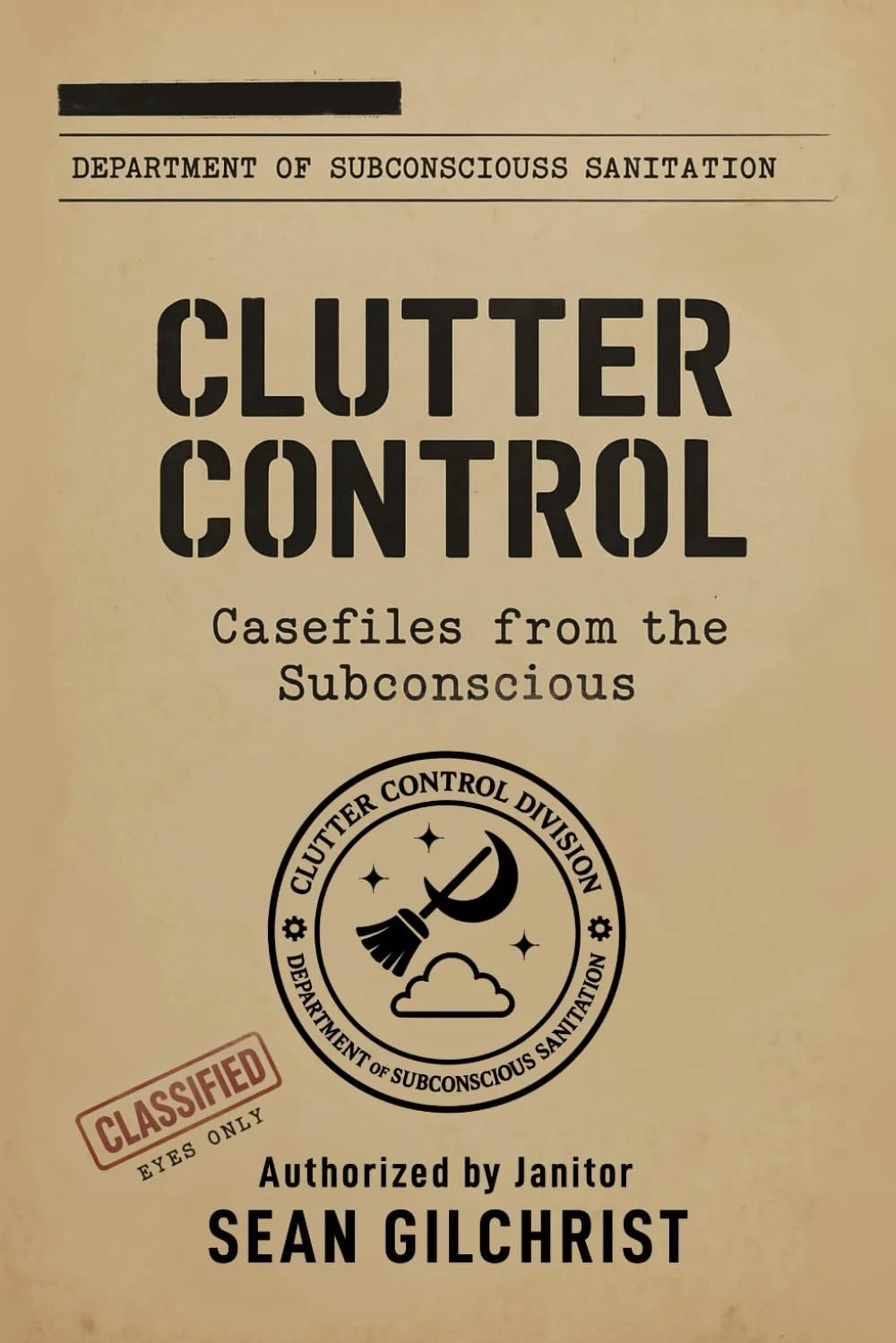
Clutter Control began as a joke about organization and quietly turned into a way of thinking about reality.
The original idea was simple: what if the chaos we experience with our unfinished thoughts, recurring dreams, emotional mess, and narrative loose ends wasn’t random? What if it was being managed, catalogued, and mishandled by a department that barely understood it themselves?
That question became Clutter Control, a fictional organization tasked with maintaining order across unstable mental, emotional, and narrative spaces. Not heroes. Not villains. Just workers. Paper-pushers. Specialists with titles that sound official enough to be reassuring and vague enough to hide the fact that no one is fully in charge.
The Incident Files are the story side of that idea. Each file documents a case that has gone wrong in some small, human, and often absurd way. A dream that refuses to resolve. A memory that keeps reappearing in the wrong place. A situation that escalates not because it’s dramatic, but because no one intervenes at the right moment.
These stories aren’t meant to build toward a grand plot. They’re procedural by design. Self-contained, loosely connected, and written from the perspective of a system trying to stay professional while everything it touches resists being categorized. Characters come and go. Authority shifts, responsibility gets reassigned, and nothing is ever fully fixed.
That structure was intentional. Real-life clutter doesn’t arrive as a single catastrophe. It accumulates through repetition. Through things being deferred, mislabeled, or quietly tolerated until they become permanent.
Alongside the Incident Files, the Clutter Control Manual emerged almost accidentally.
At some point, it became clear that the world of Clutter Control couldn’t just exist through stories. It needed paperwork. Forms. Orientation materials. Flowcharts. Guidelines that promised clarity but mostly revealed how little control anyone actually had.
Where the Incident Files show what happens on the ground, the manual shows how institutions talk about those failures after the fact. It explains procedures that don’t quite work. It defines terms that remain slippery. It offers reassurances that feel rehearsed rather than comforting.
Clutter Control isn’t really about dreams, bureaucracy, or fictional organizations. It’s about how people build systems to manage things that resist order: mental health, grief, memory, identity, unfinished ideas. It’s about how authority often exists to make chaos feel official rather than to eliminate it.
The humor comes from that gap. The sadness does too.
Clutter Control exists because I’m drawn to the spaces where structure breaks down but continues to operate anyway. Where people keep showing up, filing reports, and following procedures even when the outcome is uncertain. Where meaning isn’t resolved, just managed.
The Incident Files (01–20) are stories about things going wrong.
The manual is about pretending that’s under control.
Together, they reflect the same idea from two angles: that clutter isn’t a failure of attention, it’s a record of what we keep returning to.
And like everything else I make, Clutter Control didn’t start as a separate project. It grew out of the same pile. The same need to map chaos without flattening it. The same interest in systems that reveal themselves through their flaws.
Some worlds are built to be explored. Others are built to be maintained.
Clutter Control belongs to the second kind.